On Social Influence, Childhood Experiences, the Nervous System, and Learning to Trust Our Own Choices
When we need to make a decision, many of us almost automatically look around: What are other people doing? What do they think? Where can we find instructions or the “right” answer?
Sometimes, even in simple situations, we catch ourselves wondering: “But how would someone else do this?” “Am I doing the right thing?” “What will others think of me?”
From the outside, this may look like indecisiveness or a lack of confidence. Yet behind this behavior can lie a range of psychological mechanisms — from normal social learning to adaptation strategies developed early in life.
Human beings are social by nature. We learn by observing others, compare our experiences with those around us, and use other people's knowledge to navigate the world.
Difficulties may begin when other people's opinions become more important than our own judgment, and we start feeling unable to make decisions without external approval.
Even when we know what we want, making an independent choice may trigger anxiety, guilt, or fear of making a mistake.
Why does this happen?
In this article, we will explore what social psychology reveals about conformity, how early experiences may influence our ability to trust ourselves, the role of the nervous system and bodily sensations, and how conscious breathing and somatic practices may support greater inner stability.
1. Why Do We Follow Others in the First Place?
Before discussing trauma and the nervous system, it is important to understand one thing: observing and imitating other people is a normal part of human behavior.
From early childhood, we learn language, social norms, skills, and behavioral patterns by watching those around us.
When we find ourselves in an unfamiliar situation, looking to others can be an entirely reasonable choice. For example, in a new workplace, we observe colleagues to understand the unwritten rules. When solving a difficult problem, we seek guidance from someone with more experience.
Informational and Normative Social Influence
In social psychology, an important distinction is made between informational and normative social influence (Deutsch & Gerard, 1955).
Informational social influence occurs when we use other people's judgments as a source of information, especially in uncertain situations.
Normative social influence occurs when we adapt to a group's expectations to maintain acceptance or avoid rejection.
These motivations can operate simultaneously. A person may follow the group's opinion both because they doubt their own judgment and because they do not want to stand out.
In their review of social influence, Cialdini and Goldstein (2004) highlighted three important goals: developing an accurate understanding of reality, maintaining meaningful social relationships, and preserving a positive self-concept.
Therefore, adapting to others is not necessarily a weakness. In many situations, it is a reasonable and socially useful strategy.
What Did Solomon Asch's Experiments Reveal?
In the 1950s, social psychologist Solomon Asch investigated how the opinions of a group's majority influence individual judgment.
Participants were asked to compare the lengths of lines. The task was simple, and the correct answer was usually obvious.
However, when other group members, who were cooperating with the researcher, unanimously gave an incorrect answer, some participants conformed to the majority on certain trials.
Asch's research demonstrated that group pressure can influence a person's publicly expressed judgment, even when clear perceptual information is available (Asch, 1956).
Stanley Milgram's experiments explored another aspect of social influence — obedience to authority.
In Milgram's original experiment, many participants continued following the experimenter's instructions even though they believed they were causing pain to another person (Milgram, 1963).
These experiments revealed different processes of social influence. Asch primarily investigated majority pressure, while Milgram studied obedience to authority.
Both lines of research help us understand why human behavior does not always reflect an individual's personal beliefs.
However, neither demonstrates that conformity necessarily originates from psychological trauma.
The most important question is not whether we are influenced by others, but how much freedom we retain to exercise our own judgment and make our own choices.
Why Do We Imitate Successful and Famous People?
People do not always imitate others because they fear making mistakes or want to fit into a group. Sometimes, we copy people we admire and with whom we wish to identify.
For example, a young person may begin dressing like a popular musician, adopting their hairstyle, manner of speaking, or lifestyle. Someone else may imitate the daily habits, mindset, or behavior of a successful entrepreneur, hoping to achieve similar results.
Several psychological mechanisms are relevant here.
Social learning. Psychologist Albert Bandura demonstrated that people can learn behaviors by observing others. In his classic experiment, children imitated aggressive behavior demonstrated by an adult (Bandura et al., 1961). This helps explain why we do not necessarily need to experience the consequences of an action ourselves in order to adopt that behavior.
Prestige-based learning. Researchers in evolutionary cultural psychology, Joseph Henrich and Francisco Gil-White, proposed a model in which people tend to pay particular attention to individuals with high prestige because they may represent valuable sources of knowledge and skills (Henrich & Gil-White, 2001).
Identification with an idealized image. Celebrities may become symbols of qualities a person wishes to develop within themselves: confidence, freedom, popularity, wealth, or success. By adopting external characteristics, such as clothing or elements of a lifestyle, a person may attempt to move closer to that desired identity.
However, an important psychological mistake can occur here: we may confuse the outward signs of success with its actual causes.
A famous singer may wear a particular clothing brand, but that clothing is not what caused their musical success. A successful entrepreneur may wake up at five in the morning, but this does not mean that waking up early, by itself, created their wealth.
Success is usually influenced by an interaction of multiple factors — skills, sustained effort, opportunities, social circumstances, and luck.
It is therefore worth asking ourselves: “Am I adopting a skill or habit that could genuinely help me achieve my goal, or merely an external characteristic that I associate with success?”
Learning from successful people can be valuable. But imitating them is not the same as understanding how they became successful.
2. When Adaptation Becomes a Protective Strategy
For some people, the need for external approval becomes particularly strong.
They may constantly question their decisions, fear saying “no,” try to please everyone, or experience anxiety when they need to make an independent choice.
Such behavior can be influenced by various factors, including temperament, upbringing, social experiences, anxiety, perfectionism, self-esteem, and relationship history.
One possible influence is early emotional insecurity.
Gabor Maté: Attachment and Authenticity
Physician and author Gabor Maté emphasizes the tension between two important human needs: belonging or attachment, and authenticity.
A child needs an emotional connection with the adults on whom they depend. At the same time, they need opportunities to recognize and express their own emotions, needs, and desires.
In Maté's explanatory framework, a child who repeatedly experiences their genuine emotions or independence as a threat to important relationships may learn to adapt their behavior in order to preserve connection (Maté & Maté, 2022).
For example, a child may begin to believe:
“If I get angry, I won't be loved.”
“If I say what I really want, someone will be disappointed.”
“If I make a mistake, I will be judged.”
“It is safer to do what others want.”
Such beliefs may also influence relationships and decision-making later in life.
As an adult, a person may become so accustomed to prioritizing other people's needs that recognizing their own becomes difficult.
Importantly, Maté's attachment–authenticity conflict is an interpretative psychological framework, not an experimentally established universal explanation for why people seek external approval.
Tim Fletcher: Shame and Distrust of Ourselves
Complex trauma educator and counselor Tim Fletcher draws attention to shame and early emotional experiences.
His educational approach emphasizes that a child whose emotions are repeatedly ignored, dismissed, or punished may begin to doubt their own internal experience.
Instead of recognizing anger as a possible signal that personal boundaries have been crossed, the child may learn that feeling angry is wrong.
Instead of trusting their own needs, they may begin to view those needs as a burden on others.
In such circumstances, external approval may become a way of reducing uncertainty.
Other people may seem more confident, knowledgeable, and capable of making the right decisions.
This explanation may be useful for self-reflection, but Fletcher's specific interpretations should not be presented as independently established experimental mechanisms.
What once helped a child adapt to their relational environment may sometimes limit their independence in adulthood.
However, this does not mean that everyone who doubts themselves has experienced trauma.
3. What Happens in the Nervous System When We Fear Making Mistakes?
Anxiety about making the right decision is not merely a thought. It may also be accompanied by physiological reactions:
An increased heart rate.
Tightness in the chest or abdomen.
Changes in breathing patterns.
Sweating.
Restlessness.
Difficulty concentrating.
A desire to postpone the decision or ask someone else to decide for us.
These reactions may involve interactions between the autonomic nervous system, hormonal stress responses, and the brain's emotional regulation systems.
The autonomic nervous system helps the body adapt to different situations. Sympathetic activation can mobilize resources for action, while parasympathetic mechanisms contribute to the regulation of many bodily functions.
However, these systems do not operate like a simple switch in which one is turned on and the other is turned off.
Hypervigilance
Following prolonged experiences of insecurity or stress, some people may become particularly sensitive to signs of potential threat.
This heightened monitoring for danger is known as hypervigilance.
A person may constantly observe other people's facial expressions, tone of voice, reactions, and behavior, attempting to predict whether a situation is safe.
If receiving approval from others temporarily reduces anxiety, reassurance-seeking may become a habitual behavioral pattern.
For example, a person may only experience relief when someone says, “Yes, you are doing the right thing.”
However, short-term relief does not necessarily provide a long-term solution.
If a person regularly avoids making independent choices, they may have fewer opportunities to discover that uncertainty can be tolerated and decisions can be made without immediate reassurance.
This process can be understood partly through avoidance and safety behaviors that play a role in maintaining anxiety.
Stress and Brain Function
Research on stress and emotional regulation examines the interaction of several brain structures.
The amygdala contributes to the processing of emotionally significant information, including potential threats. Prefrontal cortical networks are involved in attentional control, evaluating situations, and regulating behavior.
Research reviewed by Arnsten (2009) indicates that stress can affect prefrontal cortex functioning, including processes related to working memory and cognitive control.
However, it would be inaccurate to claim that trauma reduces prefrontal cortex activity in the same way in everyone or always increases amygdala activity.
Brain responses depend on the individual, the situation, the task, and many other factors.
How Might Different States Influence Decision-Making?
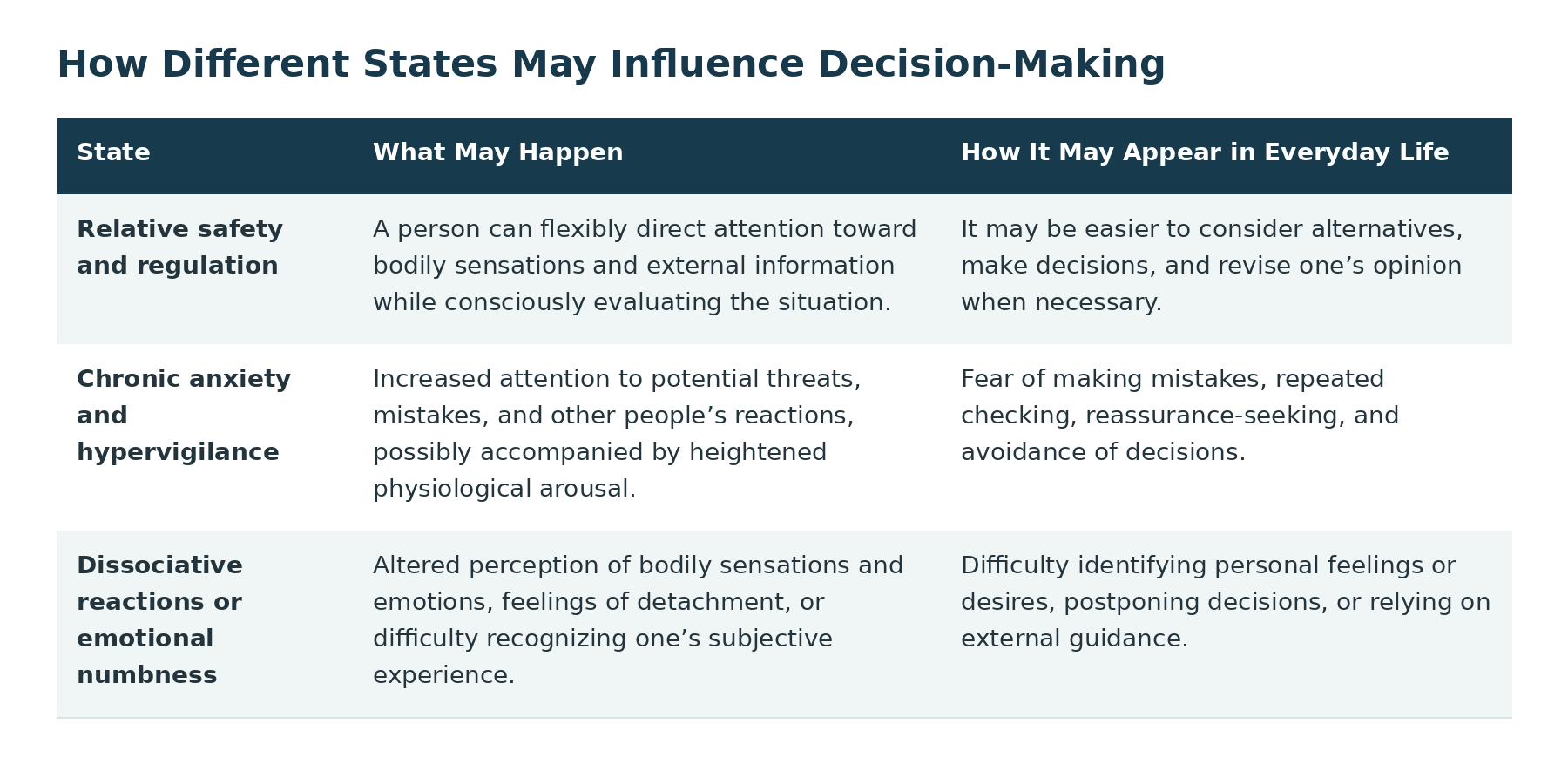
This table illustrates possible tendencies rather than fixed diagnostic categories. A person's behavior alone cannot establish a specific autonomic nervous system state or pattern of brain activity.
4. What Is the “Inner Compass” in Neurobiological Terms?
In everyday life, we often say, “I just feel that this is right,” or “Something inside me tells me this isn't right.”
We may describe such experiences as intuition or an inner compass.
However, from a scientific perspective, it is important to distinguish several processes:
Interoception — the perception of internal bodily states.
Emotional information processing.
The use of previous experiences.
Intuitive reasoning.
Conscious decision-making.
These processes can interact, but they are not synonymous.
The Vagus Nerve — Communication Between the Body and Brain
The vagus nerve (nervus vagus) is an important component of the autonomic nervous system.
It contributes to the regulation of heart function, digestion, and other bodily processes, while also transmitting information between internal organs and the central nervous system.
A large proportion of vagal fibers are afferent, meaning they carry information from the body's periphery toward the central nervous system.
This means that the vagus nerve is not simply a nerve associated with calming down. It is also an important information pathway that helps the nervous system monitor the body's internal condition.
However, communication between the body and brain does not occur exclusively through the vagus nerve. Other neural, hormonal, and immune mechanisms are also involved.
Therefore, intuition cannot be reduced to a simple pathway of “gut → vagus nerve → brain.”
The Vagus Nerve Is Not Just a Calming Nerve
The vagus nerve is frequently associated with the parasympathetic nervous system, relaxation, and bodily recovery. However, its functions extend far beyond these processes.
The vagus nerve contains both efferent fibers, which carry signals from the central nervous system to organs, and afferent or sensory fibers, which transmit information from internal organs to the brain.
These sensory signals reach the brainstem, including the nucleus tractus solitarius (NTS). From there, information can influence the locus coeruleus through interconnected neural networks.
The locus coeruleus is a brainstem structure that serves as a major source of noradrenaline, also known as norepinephrine, in the brain.
Noradrenaline contributes to the regulation of arousal, attention, and memory processes.
Research, particularly in animals, suggests that peripheral adrenaline release and activation of vagal afferent pathways can contribute to the regulation of memory for emotionally significant events (Chen & Williams, 2012).
This reveals an important distinction: the vagus nerve not only contributes to physiological regulation but also helps transmit information that can influence the brain's arousal and memory systems.
However, this does not mean that every form of vagus nerve activation automatically improves concentration or learning. Such effects depend on the specific neural pathways, the type of stimulation, and the physiological context.
This explanation also helps us understand why it is inaccurate to describe the vagus nerve solely as a nerve that switches on calmness.
It is part of a complex, two-way communication system between the body and brain.
The Insular Cortex and Interoception
The insular cortex is one of the important brain regions involved in interoception — the perception and interpretation of the body's internal states.
Interoception includes awareness of signals associated with heartbeat, breathing, hunger, thirst, and other internal sensations.
Craig (2002) described neural pathways involved in representing the body's physiological condition, paying particular attention to the insular cortex.
Khalsa et al. (2018) emphasize that interoception involves not only detecting bodily signals but also interpreting and integrating them with emotional and cognitive processes.
The insula does not function in isolation. Interoception involves broader brain networks.
This helps explain why bodily sensations can influence our emotional experiences and choices.
However, a sensation alone does not determine its meaning.
For example, tightness in the chest may be associated with fear, anxiety, physical exertion, or positive excitement.
Understanding what it means requires considering the situation and other available information.
Antonio Damasio and the Somatic Marker Hypothesis
Neuroscientist Antonio Damasio proposed the somatic marker hypothesis, which explains how experiences associated with emotions and bodily reactions may contribute to decision-making.
According to this hypothesis, previous experiences may establish emotional and physiological associations that help us evaluate the significance of possible choices (Damasio, 1996).
For example, a situation may trigger an unpleasant feeling before a person can clearly explain why it seems risky.
Such signals may help us navigate complex situations, but they can also be inaccurate.
If previous experiences involved insecurity, a person may react with anxiety even in situations where no objective threat is present.
The somatic marker hypothesis is influential, although some of its proposed mechanisms and interpretations remain subjects of scientific debate.
Our inner compass is not an infallible detector. Rather, it emerges from the interaction of bodily sensations, emotions, experiences, values, and conscious judgment.
5. Why Can Internal Signals Sometimes Become Difficult to Recognize?
Chronic stress and heightened vigilance may influence how we perceive and interpret bodily signals.
If our attention is constantly directed toward potential threats and other people's reactions, our own needs and desires may become less noticeable.
A person may be exceptionally good at noticing when someone else is dissatisfied, yet find it much harder to answer the question, “What do I actually want right now?”
They may experience tension, restlessness, or fear without necessarily understanding what those sensations mean.
For example, someone may want to decline an invitation, but as soon as they imagine saying “no,” anxiety arises in their body.
They may interpret this anxiety as a sign that declining is the wrong choice.
However, another explanation is possible: the reaction may be connected to a previously learned belief that saying “no” leads to criticism or conflict.
This is an important distinction.
A bodily reaction is real, but our interpretation of it is not always accurate.
One theoretical approach to interoception suggests that the brain does not merely receive bodily signals but also interprets them in the context of previous experiences and expectations (Seth, 2013).
This is an influential explanatory framework, not proof that every anxiety response results from an inaccurate prediction.
Therefore, reconnecting with ourselves does not mean automatically following every sensation.
It means developing the ability to notice our internal experiences, understand their possible causes, and compare them with the reality of the present situation.
Sometimes this may mean trusting our initial feeling. At other times, it may mean consciously acting despite an initial fear response.
For example, someone may feel anxious before an important conversation while also knowing that having this conversation aligns with their values and needs.
In such a case, the presence of anxiety does not necessarily mean the choice is wrong.
6. How Can Breathwork and Somatic Practices Help?
Conscious breathing and somatic practices may provide tools for paying attention to bodily sensations, regulating physiological arousal, and maintaining presence during challenging situations.
However, these approaches are not universal solutions, and research has not established that they automatically restore intuition or independent decision-making.
6.1. Reducing Excessive Physiological Arousal
Slow, comfortable breathing may help reduce subjective stress under certain conditions and influence measures of autonomic regulation.
In their systematic review, Zaccaro et al. (2018) examined the psychophysiological correlates of slow breathing, including changes in heart rate variability and other physiological measures.
Fincham et al. (2023a), in a meta-analysis combining 12 randomized controlled trials involving 785 adults for the primary stress outcome, found a small-to-moderate average effect on reducing subjective stress compared with control conditions.
However, most of the included studies had methodological limitations.
It is also important to consider studies that did not identify a specific benefit from a particular breathing rhythm.
In a randomized trial involving 400 participants, Fincham et al. (2023b) compared slow breathing at approximately 5.5 breaths per minute with controlled breathing at approximately 12 breaths per minute.
Both groups experienced improvements in well-being, but no statistically significant between-group difference was found for the primary subjective stress outcome.
In another randomized trial, Balban et al. (2023) found that brief structured breathing practices, particularly an exhalation-focused technique known as cyclic sighing, produced better results on certain outcomes than the mindfulness meditation condition used for comparison.
Taken together, these findings suggest potential benefits but do not establish that one particular breathing technique is best for everyone.
In practical terms, it may sometimes be helpful to pause before a difficult decision, notice the support beneath your body, and take a few calm, comfortable breaths.
The aim is not to force the body to relax, but to create conditions in which the situation can be evaluated more clearly.
6.2. Developing Interoceptive Awareness
Body scanning, mindfulness practices, and somatic attention may help people notice their internal sensations.
For example:
Is my breathing calm or accelerated?
Where do I notice tension in my body?
Does this sensation change when I pay attention to it?
What emotions or thoughts arise alongside this sensation?
Does this reaction correspond to the present situation, or does it feel familiar from previous experiences?
Research on interoception indicates that the perception and interpretation of internal bodily signals are associated with emotional experience and various mental health processes (Khalsa et al., 2018).
However, paying greater attention to bodily sensations does not always automatically improve well-being.
For people experiencing significant anxiety or trauma-related difficulties, focusing inward may sometimes increase discomfort.
For this reason, practices should be gradual and adapted to individual needs.
6.3. Working With Protective Responses and Boundaries
Peter Levine's Somatic Experiencing approach places considerable emphasis on bodily responses associated with threat, mobilization, and protection.
The approach uses the idea that gradual engagement with bodily sensations and movement may help people process stress-related experiences.
In practice, this may involve noticing an impulse to step back, protect oneself, straighten the body, say “no,” or adopt a more stable physical posture.
In a randomized controlled trial involving 63 participants diagnosed with post-traumatic stress disorder (PTSD), Brom et al. (2017) found positive outcomes in the Somatic Experiencing intervention group compared with a waitlist control group.
This provides preliminary empirical support for the possible effectiveness of this approach under certain conditions.
However, the study does not demonstrate that Somatic Experiencing is superior to other active psychotherapies. Nor does it establish all the theoretical mechanisms proposed by the approach, including the idea that trauma is literally stored in muscles or that trembling always represents the completion of an unfinished defensive response.
At the same time, becoming aware of personal boundaries and gradually developing the ability to express one's needs may be an important part of psychological growth.
For someone who has spent years adapting to others, even a simple sentence such as “I don't want to do that this time” can feel emotionally challenging.
6.4. Expanding Our Capacity to Tolerate Uncertainty
In psychotherapy, the concept of the window of tolerance is sometimes used to describe a range of arousal within which a person may find it relatively easier to maintain emotional regulation and engage with their environment.
It is a useful clinical model, not a precisely measurable nervous system state with universal boundaries.
For someone accustomed to seeking external approval, making an independent choice may create considerable discomfort.
In such situations, the goal is not necessarily to eliminate anxiety completely before making a decision.
Sometimes, what matters more is learning to make small decisions even when uncertainty remains present.
For example, a person may begin with everyday choices that have limited consequences: selecting an activity that suits them, expressing an opinion, or politely declining an invitation.
Over time, such experiences may help strengthen confidence in one's ability to make decisions.
Breathing and body awareness may support this process, but they do not replace the practical experience of making choices independently.
7. How Can the Decision-Making Process Change?
To illustrate the difference, let us compare two possible behavioral patterns.
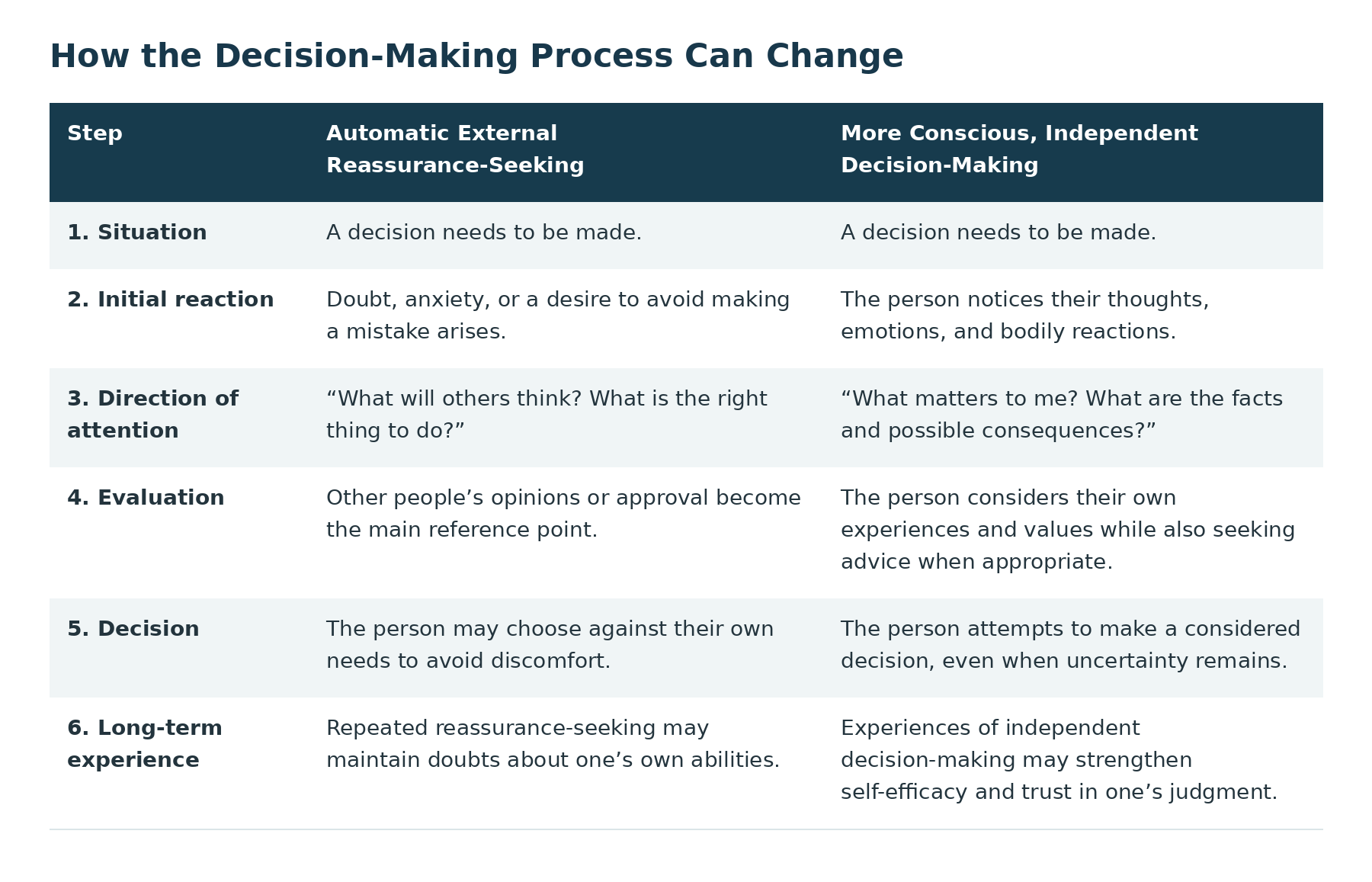
These patterns do not represent two fixed categories of people. Each of us may use both approaches in different situations.
Independent decision-making also does not mean ignoring other people's knowledge, experience, or advice.
The goal is not to stop listening to others. The goal is to learn to listen to ourselves as well.
8. A Simple Practice: Before Asking Others, Ask Yourself
If you notice that you automatically seek external reassurance, you can try a simple self-reflection practice.
This is a practical reflection exercise, not a separately validated clinical treatment protocol.
1. Notice the Impulse
When you feel the urge to immediately ask someone else what to do, pause for a moment.
Ask yourself: “Am I genuinely missing information, or am I looking for reassurance that I won't make a mistake?”
2. Bring Attention to Your Body
Notice the contact of your feet with the ground, the support beneath your body, and the rhythm of your breathing.
There is no need to change your breathing or create any particular sensation. If it feels comfortable, you may take a few calm, natural breaths.
3. Name Your Experience
For example: “I feel tension in my stomach, and I'm afraid of making the wrong decision.”
Instead of automatically interpreting the sensation as a warning, try treating it as information.
4. Separate the Sensation From the Conclusion
“I feel afraid” is not the same as “This decision is wrong.”
Ask yourself whether there are concrete facts suggesting a risk, or whether your reaction may be more closely related to uncertainty and previous experiences.
5. Make One Small Independent Choice
Begin with a situation in which the consequences of making a mistake are relatively minor.
The goal is not to make a perfect decision. The goal is to gain experience in choosing, tolerating uncertainty, and adjusting your actions when necessary.
If a decision is complex or involves health, finances, or other significant risks, seeking professional advice remains a sensible and valuable choice.
9. Important Considerations and Precautions
Intuition is not infallible. Bodily reactions may provide valuable information, but they can also be influenced by anxiety, previous experiences, fatigue, health conditions, and cognitive biases.
Not all conformity is trauma-related. People may follow others because of social learning, cultural norms, lack of experience, or practical considerations. Excessive reassurance-seeking alone is not sufficient evidence that someone has complex trauma.
Breathing practices are not all the same. Calm, comfortable breathing and intense, prolonged connected breathing may produce very different physiological and emotional responses. Intense breathing may lead to dizziness, tingling, strong emotions, and other symptoms that can also be associated with overbreathing and reduced carbon dioxide levels in the blood.
Practices should be adapted to the individual. For people experiencing panic attacks, dissociative responses, significant trauma-related difficulties, or medical conditions, an individualized approach is especially important. Sometimes it may be more appropriate to begin with observing the external environment, movement, or other stabilizing techniques rather than intense attention to internal sensations.
Somatic and breathing practices do not replace necessary treatment. If difficulties significantly affect everyday life, relationships, or the ability to make decisions, consulting a qualified mental health professional may be helpful.
This article is intended for educational purposes and does not replace individualized medical or psychotherapeutic advice.
Conclusion: From External Approval to Inner Trust
We all look to others. We learn, compare, ask questions, and sometimes adapt. This is part of our social nature.
Yet for some people, the opinions of others gradually become the primary measure of safety and correctness.
If independence, emotional expression, or setting boundaries were associated with criticism, conflict, or insecurity during early life, these behavioral patterns may persist into adulthood.
The path toward greater self-trust does not always begin with confidence. Sometimes, it begins with the ability to notice: “Right now, I'm afraid of making a mistake.”
And then, with the possibility of tolerating that feeling without automatically turning it into a response of conformity.
Conscious breathing, somatic awareness, psychological self-reflection, and gradually gaining experience with independent choices may all support this process.
Not because the body always knows the correct answer, but because we can learn to understand our reactions more clearly and avoid allowing them alone to determine our choices.
True self-trust does not mean always knowing the right answer. It means being able to make a decision, take responsibility, and remain connected with ourselves even when uncertainty is present.
And then the question “What are other people doing?” may gradually become:
“What do I think, feel, and choose — while considering both myself and the world around me?”
References
Arnsten, A. F. T. (2009). Stress signalling pathways that impair prefrontal cortex structure and function. Nature Reviews Neuroscience, 10, 410–422. https://doi.org/10.1038/nrn2648
Asch, S. E. (1956). Studies of independence and conformity: I. A minority of one against a unanimous majority. Psychological Monographs: General and Applied, 70(9), 1–70. https://doi.org/10.1037/h0093718
Balban, M. Y., Neri, E., Kogon, M. M., Weed, L., Nouriani, B., Jo, B., Holl, G., Zeitzer, J. M., Spiegel, D., & Huberman, A. D. (2023). Brief structured respiration practices enhance mood and reduce physiological arousal. Cell Reports Medicine, 4(1), Article 100895. https://doi.org/10.1016/j.xcrm.2022.100895
Bandura, A., Ross, D., & Ross, S. A. (1961). Transmission of aggression through imitation of aggressive models. The Journal of Abnormal and Social Psychology, 63(3), 575–582. https://doi.org/10.1037/h0045925
Brom, D., Stokar, Y., Lawi, C., Nuriel-Porat, V., Ziv, Y., Lerner, K., & Ross, G. (2017). Somatic experiencing for posttraumatic stress disorder: A randomized controlled outcome study. Journal of Traumatic Stress, 30(3), 304–312. https://doi.org/10.1002/jts.22189
Chen, C. C., & Williams, C. L. (2012). Interactions between epinephrine, ascending vagal fibers, and central noradrenergic systems in modulating memory for emotionally arousing events. Frontiers in Behavioral Neuroscience, 6, Article 35. https://doi.org/10.3389/fnbeh.2012.00035
Cialdini, R. B., & Goldstein, N. J. (2004). Social influence: Compliance and conformity. Annual Review of Psychology, 55, 591–621. https://doi.org/10.1146/annurev.psych.55.090902.142015
Craig, A. D. (2002). How do you feel? Interoception: The sense of the physiological condition of the body. Nature Reviews Neuroscience, 3(8), 655–666. https://doi.org/10.1038/nrn894
Damasio, A. R. (1996). The somatic marker hypothesis and the possible functions of the prefrontal cortex. Philosophical Transactions of the Royal Society of London. Series B: Biological Sciences, 351(1346), 1413–1420. https://doi.org/10.1098/rstb.1996.0125
Deutsch, M., & Gerard, H. B. (1955). A study of normative and informational social influences upon individual judgement. The Journal of Abnormal and Social Psychology, 51(3), 629–636. https://doi.org/10.1037/h0046408
Fincham, G. W., Strauss, C., Montero-Marin, J., & Cavanagh, K. (2023a). Effect of breathwork on stress and mental health: A meta-analysis of randomised-controlled trials. Scientific Reports, 13, Article 432. https://doi.org/10.1038/s41598-022-27247-y
Fincham, G. W., Strauss, C., & Cavanagh, K. (2023b). Effect of coherent breathing on mental health and wellbeing: A randomised placebo-controlled trial. Scientific Reports, 13, Article 22141. https://doi.org/10.1038/s41598-023-49279-8
Henrich, J., & Gil-White, F. J. (2001). The evolution of prestige: Freely conferred deference as a mechanism for enhancing the benefits of cultural transmission. Evolution and Human Behavior, 22(3), 165–196. https://doi.org/10.1016/S1090-5138(00)00071-4
Khalsa, S. S., Adolphs, R., Cameron, O. G., Critchley, H. D., Davenport, P. W., Feinstein, J. S., Feusner, J. D., Garfinkel, S. N., Lane, R. D., Mehling, W. E., Meuret, A. E., Nemeroff, C. B., Oppenheimer, S., Petzschner, F. H., Pollatos, O., Rhudy, J. L., Schramm, L. P., Simmons, W. K., Stein, M. B., . . . Paulus, M. P. (2018). Interoception and mental health: A roadmap. Biological Psychiatry: Cognitive Neuroscience and Neuroimaging, 3(6), 501–513. https://doi.org/10.1016/j.bpsc.2017.12.004
Maté, G., & Maté, D. (2022). The myth of normal: Trauma, illness, and healing in a toxic culture. Avery.
Milgram, S. (1963). Behavioral study of obedience. The Journal of Abnormal and Social Psychology, 67(4), 371–378. https://doi.org/10.1037/h0040525
Seth, A. K. (2013). Interoceptive inference, emotion, and the embodied self. Trends in Cognitive Sciences, 17(11), 565–573. https://doi.org/10.1016/j.tics.2013.09.007
Zaccaro, A., Piarulli, A., Laurino, M., Garbella, E., Menicucci, D., Neri, B., & Gemignani, A. (2018). How breath-control can change your life: A systematic review on psycho-physiological correlates of slow breathing. Frontiers in Human Neuroscience, 12, Article 353. https://doi.org/10.3389/fnhum.2018.00353